
How to Read a Racing Program Without Feeling Lost
You pick it up at the gate, flip through a few pages, and immediately feel like you're reading a foreign language. Numbers, abbreviations, tiny print, and not a single explanation in sight.
That's the racing program — and it's intimidating until it isn't.
Here's the thing: you don't need to understand every line. You need to understand the right lines. Let me walk you through what's actually on the page, section by section.
The Race Card
The program opens with a race card — a full list of every race running that day, in order. Think of it as the day's schedule. Each race has a number, a post time, and a brief description of what kind of race it is (more on that in a moment).
Start here. It tells you how many races are on the card (usually 8–12), which one the big stakes race is, and roughly how long your day is going to be. Races run about 30 minutes apart, so you can plan your afternoon accordingly.
The Race Conditions
At the top of each individual race page, you'll see a block of text that looks something like this:
"For Three Year Olds and Upward. Non-winners of two races at a mile or over since April 1."
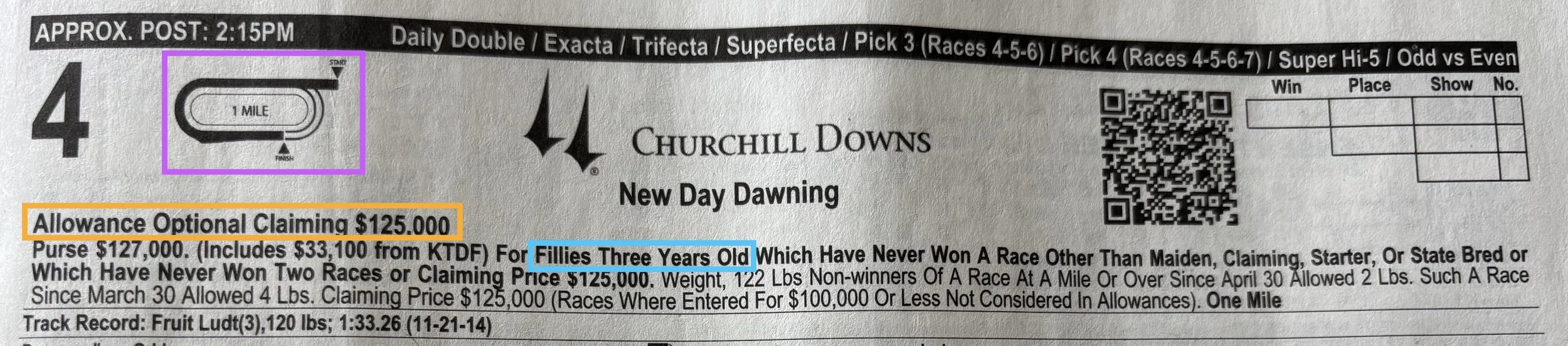
This is the conditions box, and it tells you exactly who is eligible to run in this race. Don't overthink it. The key things to scan for are:
Age — Are these young horses (2- or 3-year-olds) or older ones?
Distance — Is this a sprint (under a mile) or a route (a mile or more)? It also depicts if it is on the inner turf course or outer dirt course and where the start and finish will occur.
Class — Words like maiden, claiming, allowance, and stakes indicate the level of competition. Stakes races are the most prestigious; maiden races are for horses that have never won. Higher purses typically mean higher caliber horses.
The Horse's Name and Basic Info
Each horse's entry starts with its name, followed by details like age, color, sex, and breeding. Just below that you'll find the jockey and trainer names.

Trainer and jockey stats are printed in the program for a reason — a hot trainer or a jockey on a winning streak matters. If you see a name with a high win percentage next to it, pay attention.
The Past Performances
This is the meaty middle section — the rows of numbers that look like a spreadsheet had a bad day. Each horse in the race gets its own block, and inside that block is a line-by-line history of its recent races.
You don't need to decode all of it. Focus on these columns:
Date and track — When and where did this horse last run?
Distance — Has it run this distance before?
Finish position — That number at the far right. A string of low numbers (1, 2, 3) means a horse that consistently finishes up front. A string of 7s and 8s? Not so much.
Odds — What did the crowd think of this horse last time? If it was heavily favored and still finished fifth, that's worth noting.
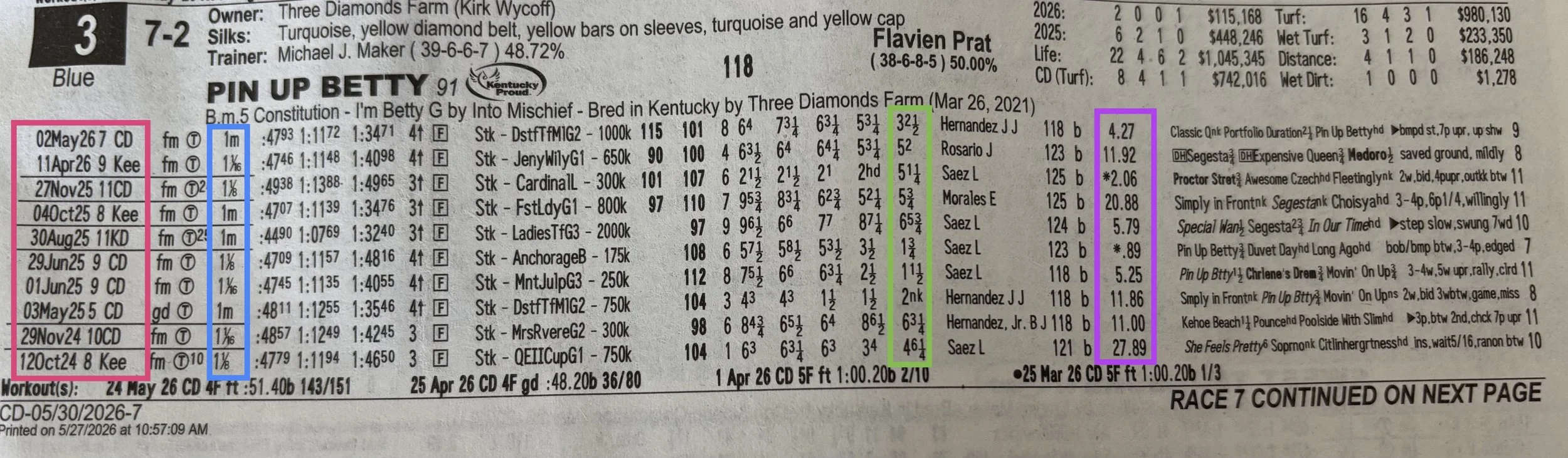
The past performances are where the real handicapping happens — but even a casual read gives you a feel for which horses are in form and which ones are not.
The Morning Line Odds
On the right side of each horse's entry, you'll see a fraction — something like 5/2 or 8/1. These are the morning line odds, set by the track's official handicapper before betting opens.
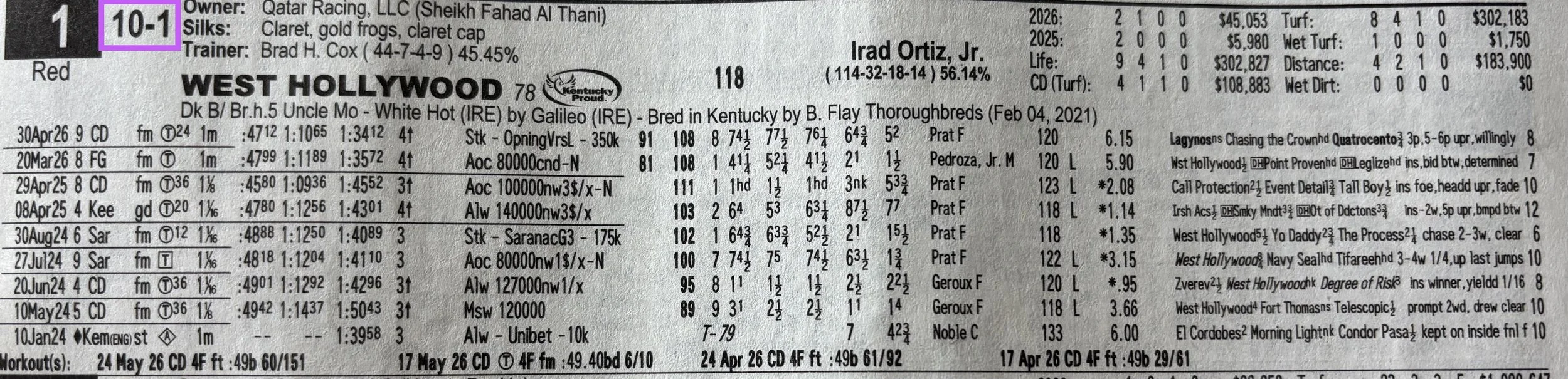
Think of them as a starting suggestion, not a final answer. By the time the race goes off, the actual odds will have shifted based on where the crowd puts their money. But the morning line gives you a quick read on who the experts think has a shot. The higher the number, the longer the odds and the crowd thinks they have a lower chance of winning. The lower the number, the shorter the odds. Higher odds = larger payouts.
You Don't Need to Know Everything
The program is designed for serious handicappers who spend hours studying horses. You are not required to be that person. If you want additional insight, there is a key at the start of the program which explains each and every number, letter, symbol, etc. Horse racing is like a big puzzle— the more you learn, the more interesting it gets!
Pick one or two things to focus on each race — maybe just the past finish positions, or just the odds — and build from there. The more races you watch, the more the numbers start to tell a story.
By race five, you'll be reading it like you've been doing it for years.
